
CalorGrid
Turning Distributed Server Heat Into Useful Building Heating Across Switzerland
14 Swiss building digital twins · 136 liquid-cooled racks · 484 MWh/yr recovered heat · 0 kWh wasted
Basel Klingental Home
4 x 1 kW racks · 34.1% annual heat covered
Basement Heat Exchanger
80% heat transfer (55/45 C water) · 35 kWh buffer
Gartenbad St. Jakob Pool
Absorbs summer compute · 96.2% utilisation

configure your building
Vaibhav Motwani · Prakash Aryan · Vilas Harapanahalli
Scan either QR code to open the live Swiss digital twin or interactive deck

downloadable PDF
[0:00-0:25] Data centers reject nearly 100% of their electricity as waste heat, while Swiss buildings still pay every winter to heat water. CalorGrid links 136 liquid-cooled servers across 14 real Swiss building twins, recovering 484 MWh of useful heat per year with zero wasted energy.
The Problem: Waste Heat vs. Seasonal Demand
Moving servers into a single home saves heat in winter, yet breaks down across 3,816 warm summer hours
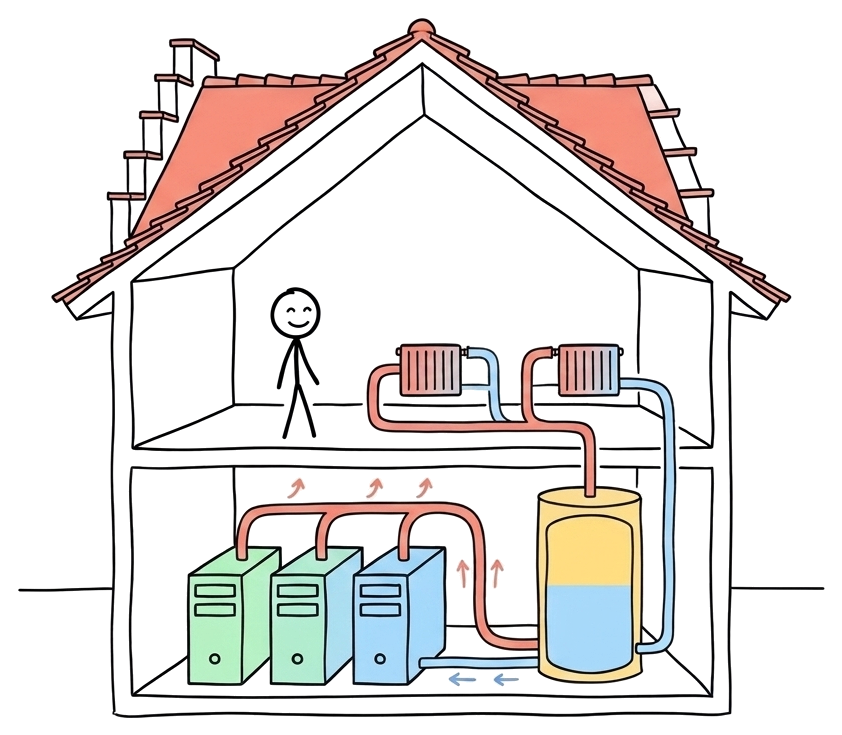
Basel 2025 Reference House: 31.2 MWh/yr demand (206 cold days), but only 12 kWh/day hot-water demand in July
Cloud facilities consume electricity to run compute, then spend extra cooling power venting that thermal energy into the air while nearby buildings burn gas or electricity for heating.
Running 4 x 1 kW servers continuously in one Basel home covers 32.7% of winter heat, but dumps 3,790 kWh/yr outdoors once the 35 kWh buffer fills in summer (raising OPEX to 0.255 CHF/srv-h).
Thermal-led pausing eliminates dumping (0.0 kWh) and cuts electricity by CHF 1,401/yr, yet servers sit idle across summer, leaving utilisation at 38.0% and full CAPEX+OPEX at 0.65 CHF/srv-h.
Basel 2025 benchmark: Open-Meteo 8,760 h (206 heating days, -5.6 C min, 31,231 kWh demand), ElCom 2026 IWB H4 (0.3325 CHF/kWh excl. VAT), 4 x 1 kW servers, 35 kWh buffer tank.
[0:25-1:05] Here is the core problem. Traditional data centers vent their heat to the sky. Installing 4 liquid-cooled servers in a Basel house performs effectively in winter, covering 34% of demand. Across 3,816 warm summer hours, uncoordinated servers reject 3,790 kWh outdoors, while pausing them leaves hardware idle and raises full cost to 65 Rappen per server-hour.
Our Solution: Smart Heat Control + Fiber Routing
Heat stays local in the basement; compute migrates in 2-4 ms over Swiss fiber to buildings with active thermal demand
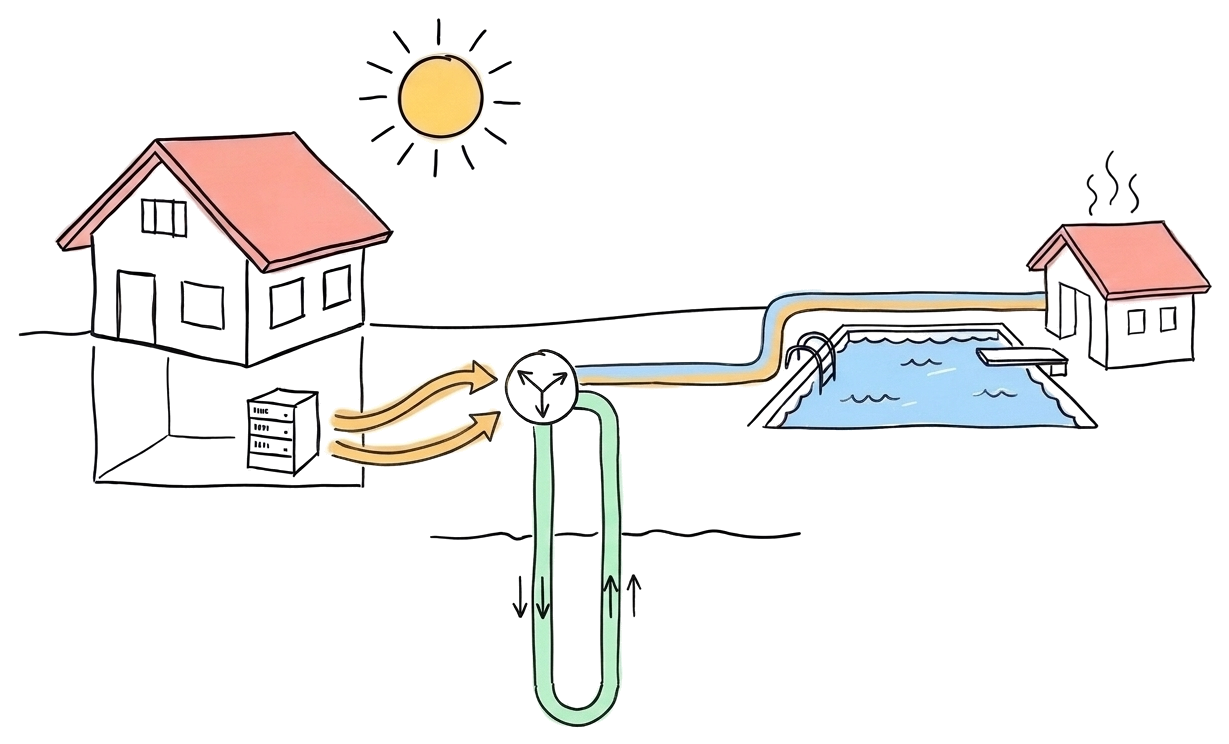
Before vs. With CalorGrid (8,760 h Engine)
| Operating Mode | Dumped | Util | OPEX / Full |
|---|---|---|---|
| Uncoordinated House | 3,790 kWh | 50.0% | 0.255 / 0.57 |
| CalorGrid Smart House | 0.0 kWh | 38-65% | 0.226 / 0.47-0.65 |
| CalorGrid + Summer Sink | 0.0 kWh | 96.2% | 0.226 / 0.39-0.43 |
| CalorGrid 14-Site Fleet | 0.0 kWh | 89.6% | 0.193 / 0.51 |
Sealed non-conductive dielectric coolant cools the servers and transfers heat via a plate exchanger (CDU) into the 35 kWh water buffer at 55/45 C, heating buildings directly without a heat pump.
Every hour, our Python controller (decide_live_step()) checks tank state-of-charge and weather, dispatching or suspending batch jobs (OCR, embeddings, LLMs) via Linux SIGSTOP/SIGCONT.
When residential buffers fill in summer, CalorGrid migrates batch compute in 2-4 ms over Swiss fiber to active summer heat sinks: pools, dairy farms, glasshouses, boreholes, hospitals and Alpine spas.
All scenarios satisfy strict hourly energy conservation (residual <= 7.3e-9 kWh). Paired sink figures span full vs zero secondary-sink heat credit; central server CAPEX = 1,400 CHF/srv-yr.
[1:05-1:50] CalorGrid solves this in three steps. First, direct liquid cooling captures 80% of server electricity as 55 degree warm water. Second, our thermal scheduler tracks the 35 kWh buffer and pauses local batch jobs before a single watt is dumped. Third, instead of building district pipes, we shift batch compute over Swiss fiber in 2 to 4 milliseconds to pools, dairy farms, boreholes and hospitals that need heat all summer, lifting utilisation to 96% and reducing full break-even from 65 down to 39 Rappen per server-hour.
Scaling Across Switzerland: 14 Digital Twins
136 liquid-cooled racks linked across 10 cantons · 484 MWh/yr useful heat · 0 kWh dumped nationwide
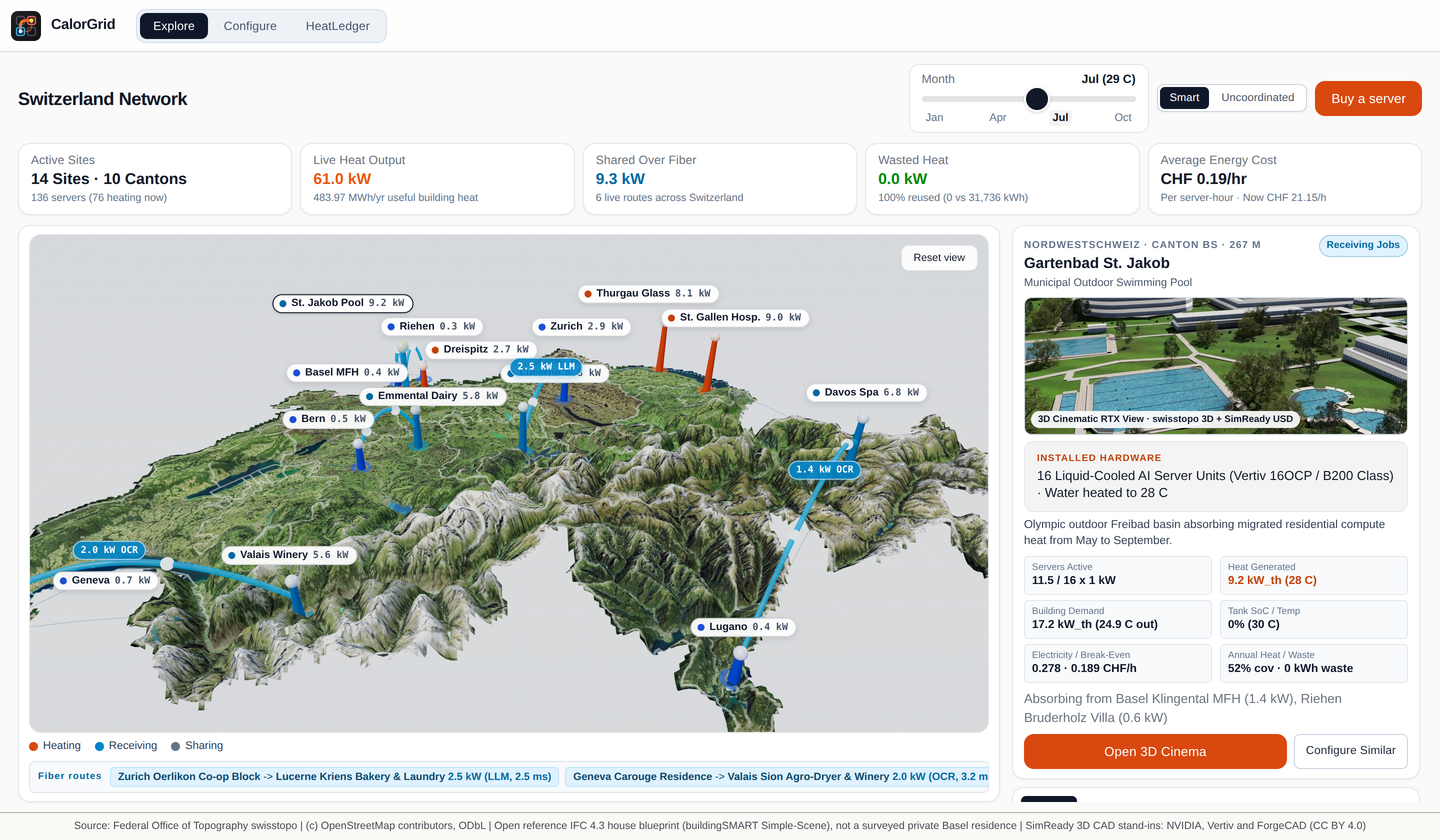
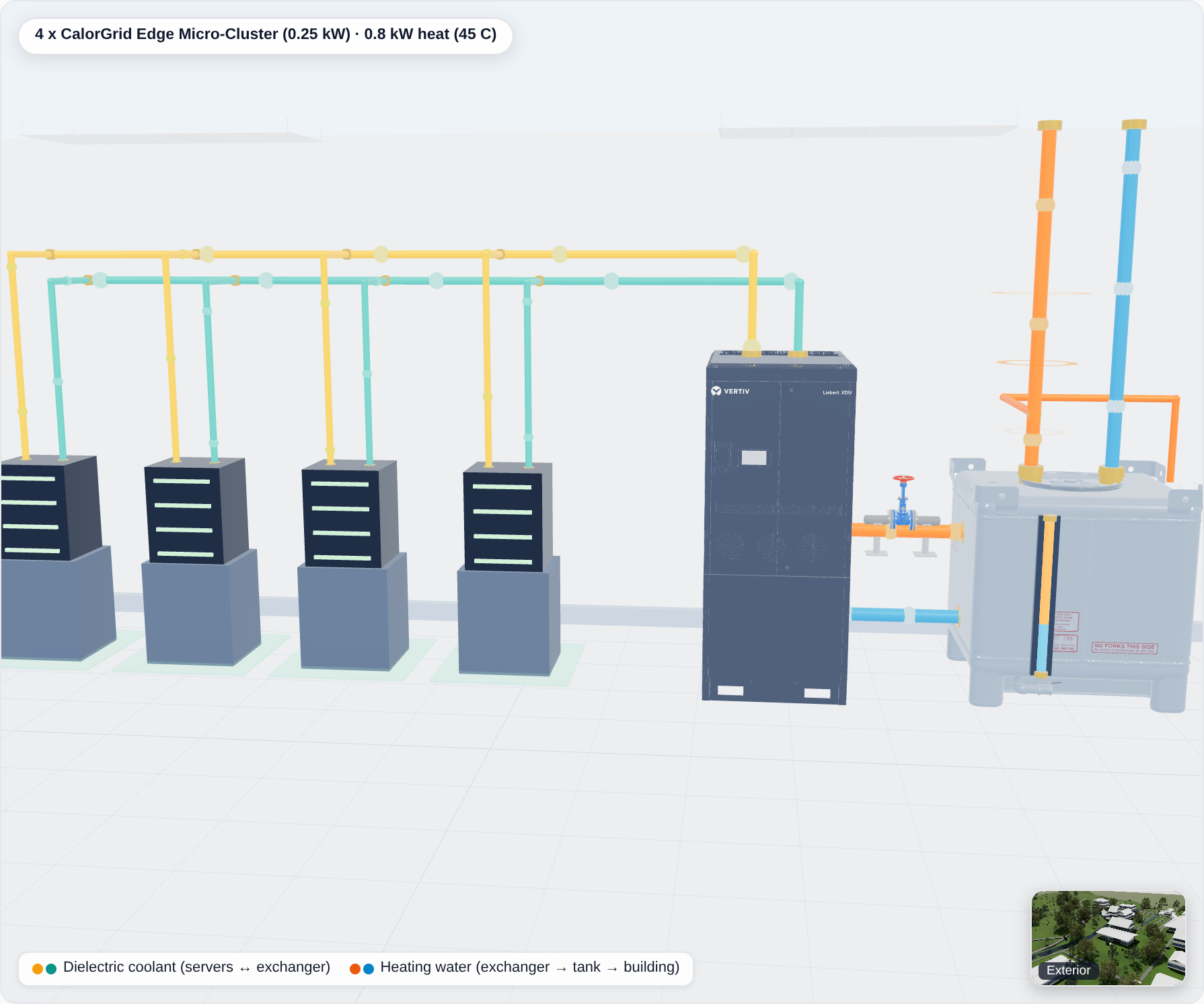
Compact Utility Closet
4 x 0.25 kW Edge · 0.8 kW heat (45 C)
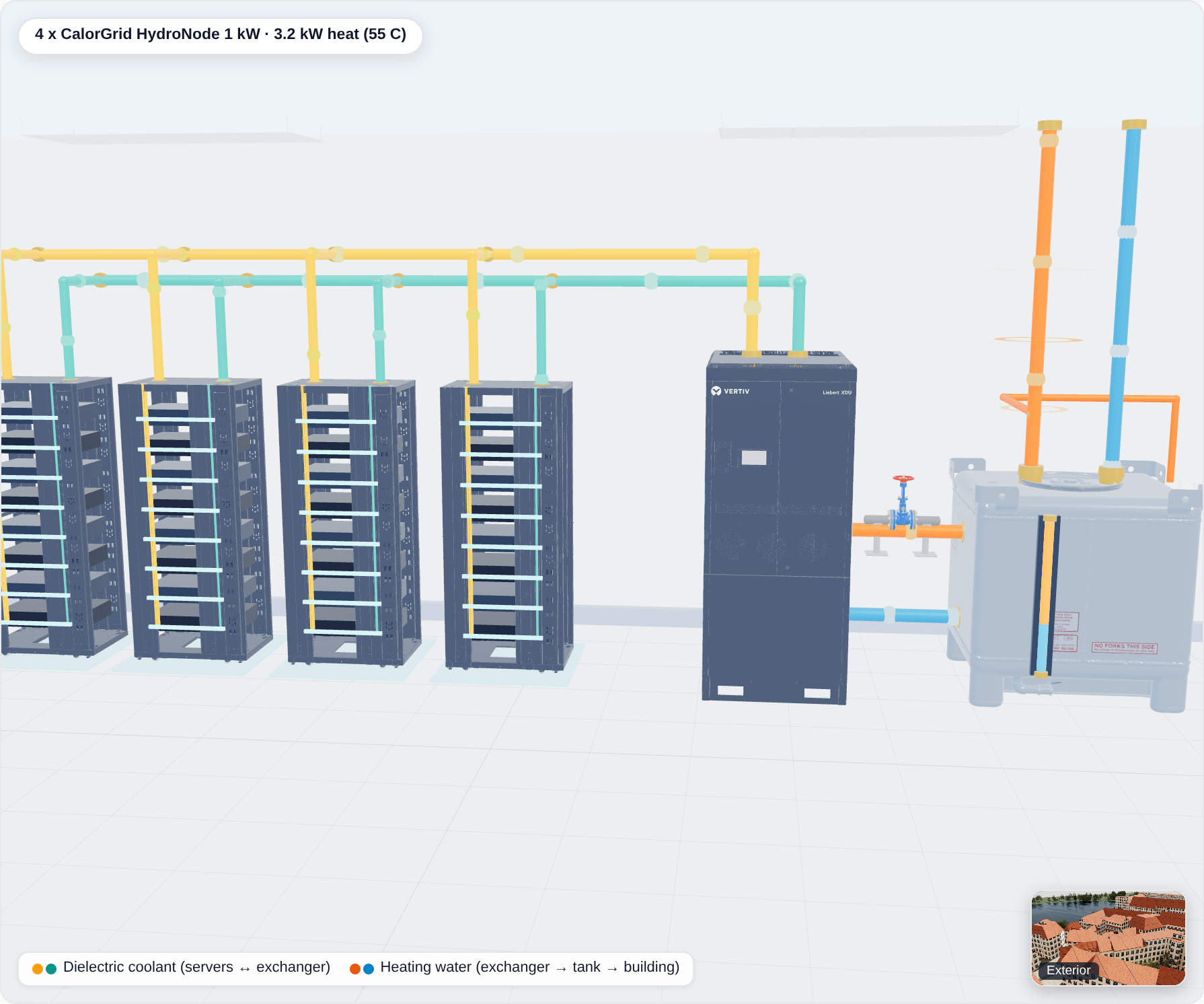
Basel Concrete Basement
4 x 1.0 kW HydroNode · 3.2 kW heat (55 C)
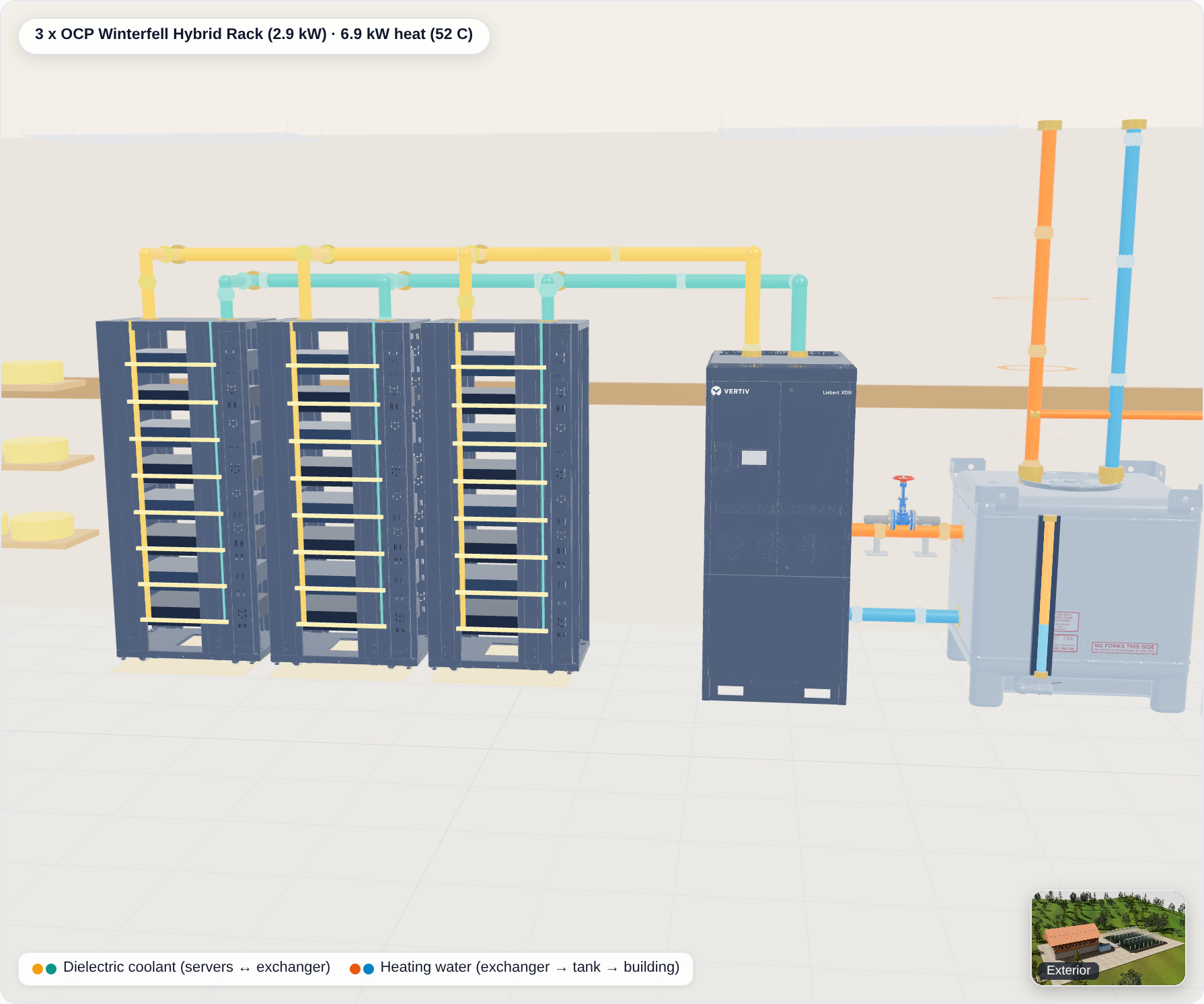
Emmental Dairy Utility Room
3 x 2.9 kW Winterfell · 6.9 kW heat (52 C)
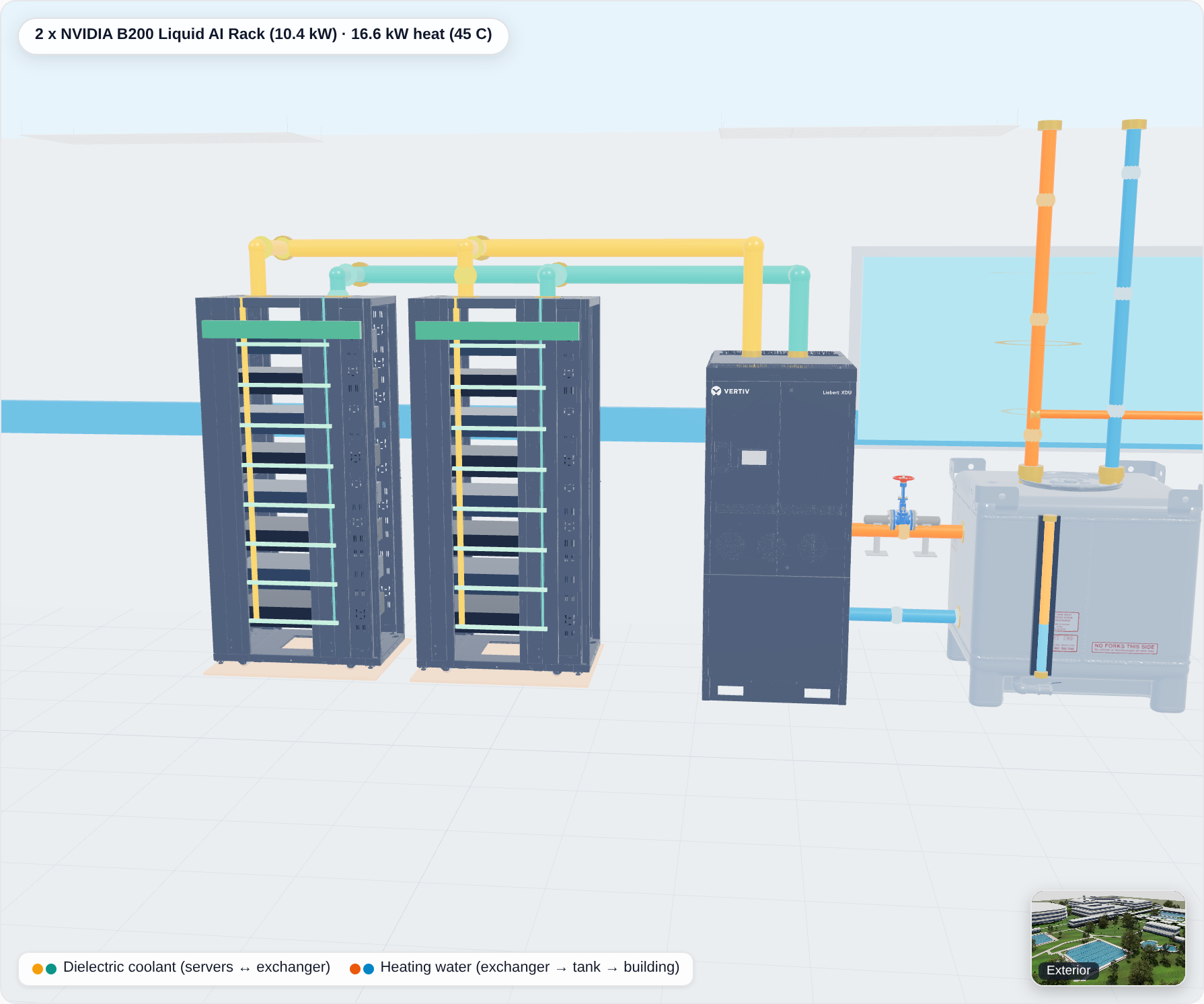
St. Jakob Pool Plant Room
2 x 10.4 kW B200 AI · 16.6 kW heat (45 C)
All 14 Swiss building exteriors are rendered in Isaac Sim 6.2 RTX from real swisstopo 3D geometry; each interior digital twin displays live liquid-cooled server sizing, Liebert CDU exchange, buffer tank and flowing thermal load.
[3:45-4:25] When we scale from one Basel home to 14 photorealistic digital twins across 10 Swiss cantons, the economics transform. In January every site absorbs 100% of its heat locally. In summer, warm homes in Bern, Geneva and Lugano shift nearly 40,000 server-hours per year to outdoor pools, Emmental dairy farms, Thurgau glasshouses and St. Gallen hospital, cutting 31.7 MWh of summer waste to zero and lowering fleet OPEX break-even to 19.3 Rappen per server-hour.
Engineering Rigor & 3-Phase Swiss Rollout
Every real-world tariff, idle-power and thermal boundary is engineered directly into our deployment sequence
Built for Real-World Swiss Economics
Anchoring first deployments on commercial C6 tariffs (0.253 CHF/kWh vs retail H4 0.333) saves 8.0 Rp/kWh, keeping 100% of the displaced heat credit intact and achieving 0.386 CHF/srv-h incl. CAPEX.
HEATWISE measurements show 21-27% idle power under OS pause alone. CalorGrid combines hardware sleep states with 35-45 C warm-water sinks so servers stay cool (54.9 C) and reach 96-100% utilisation.
Built-in 4-category 3D Provenance Mode labels live OS telemetry, pinned datasets and OEM CAD models transparently, backed by 77/77 unit tests and 125/125 Chrome E2E tests.
Basel-to-Switzerland Pilot Roadmap
Deploy 4-16 racks at 35-45 C facilities (thermal baths, municipal pools, commercial laundries): 100% util · 0.386 CHF/srv-h.
Connect Basel residential basements with SIA 384/6 ground-source borehole recharge: 96.2% util · -89.4% dump · 0.39-0.43 CHF/h.
Activate fiber workload orchestration across cantons (homes, dairies, glasshouses, hospitals, Alpine spas): 0.0 kWh dumped · 0.193 CHF/h OPEX.
Attributions: (c) swisstopo; (c) OpenStreetMap contributors, ODbL; (C) buildingSMART International Ltd. (CC BY 4.0); NVIDIA, Vertiv and ForgeCAD SimReady (CC BY 4.0). Literature: ETH Zurich Aquasar (2012).
[4:25-5:00] Because we modelled Swiss tariffs, HEATWISE idle draw and ASHRAE W45 temperatures from the outset, our rollout path is directly actionable. Phase 1 launches at year-round commercial hosts in Basel at 38.6 Rappen all-in. Phase 2 adds borehole-paired residential homes at 96% utilisation. Phase 3 scales our fiber scheduler nationwide. Scan the QR code to try the live CalorGrid platform yourself. We are Team Invincibles. We are ready for your questions.